• SR22

    Secondary Standard Pyranometer with Quartz Domes - Extended Spectral Range

    SR22 is a solar radiation sensor of the highest category in the ISO 9060 classification system: secondary standard. On top of the features and benefits of the successful SR20 pyranometer, SR22 has domes made of high-quality quartz, resulting in an extended spectral range. Covering the full solar spectrum, SR22’s extended spectral range potentially offers lower measurement- and calibration uncertainties compared to pyranometers with glass domes. SR22 is typically used in high-accuracy climatological networks.
    • SR22’s spectral range of 190 to 4000 x 10-9 m. SR22 covers the full solar spectrum
    • SR22’s low temperature dependence makes it an ideal candidate for use under very cold and very hot conditions
    • SR22 pyranometer uses a state of the art thermopile sensor with black coated surface
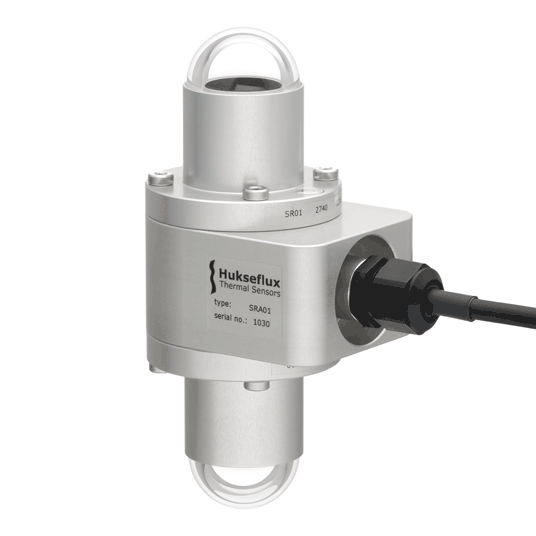
  • SRA01

    Second class albedometer

    SRA01 albedometer is an instrument that measures global and reflected solar radiation and the solar albedo, or solar reflectance. It is composed of two identical second class pyranometers with thermopile sensors, the upfacing one measuring global solar radiation, the downfacing one measuring reflected solar radiation. SRA01 complies with the latest ISO and WMO standards.
    • Measures global and reflected solar radiation and the solar albedo, or solar reflectance
    • Composed of two identical second class pyranometers with thermopile sensors
    • Complies with the latest ISO and WMO standards
  • NR01

    4-component net radiometer

    NR01 is a market leading 4-component net radiometer, mostly used in scientific-grade energy balance and surface flux studies. It offers 4 separate measurements of global and reflected solar and downwelling and upwelling longwave radiation, using 2 sensors facing up and 2 facing down. NR01 owes its popularity to its excellent price / performance ratio and major improvements relative to comparable instruments. Advantages include its modular design with 2 pairs of identical sensors, low weight, ease of leveling, and low solar offsets in the longwave measurement. The unique capability to heat the pyrgeometers reduces measurement errors caused by dew deposition.
    • Lowest price level at top level performance
    • Heated pyrgeometers, best night-time data availability
    • High-accuracy shortwave calibration
    • Low weight, low mounting costs
    • Modular design, 2 pairs of identical sensors
    • Practical leveling, servicing and recalibration
  • GT Series

    Guiding Tubes for Thermal Needles TP02, TP07 and TP08

    The GT series guiding tubes are accessories for Non-Steady-State Needle probes. They are intended to facititate measurements in hard soils, concrete, cement and bentonite. Also in case of measurements on large quantities of samples one can use several guiding tubes and one single needle.
  • CRC Series

    Calibration Reference Cylinders for Thermal Needle Probes TP02/TP08, TP07 and TP09

    CRC's contain traceable thermal conductivity reference materials for calibration of Non-Steady-State Probes. There are several different CRC types. The geometry of the different types is adapted to fit needles with a certain diameter. Hukseflux is a leading supplier of Non-Steady-State Probes, and is the inventor of the CRC calibration method.
    • Amorphous plastic reference material does not have any directionally dependent thermal properties
  • HF01

    High temperature heat flux sensor

    HF01 high temperature heat flux sensor measures heat flux and surface temperature at high temperatures, typically in industrial environments. It is particularly suitable for trend-monitoring and comparative testing. The same technology can be used to manufacture heat flux sensors for different applications.
    • Robust
    • Suitable for use at high temperatures
    • Low thermal resistance
    • High sensitivity
    • IP protection class: IP68
  • HF02

    Flare radiation monitor / heat flux sensor

    HF02 is a sensor that measures radiant heat flux or thermal radiation in the outdoor environment. A common application is monitoring the radiation emitted by flares. HF02 is certified for use in potentially explosive atmospheres, and is rated for radiation levels up to 15 x 10³ W/m². We recommend use of HF02 in a decision-supporting role only, and not to use measurements of HF02 as the main or sole source of information for judging safety.
    • Robust
    • All-weather
    • Suitable for potentially explosive environments
  • HF03-LI19

    Portable heat flux sensor, with read-out unit / datalogger

    HF03 is a heat flux sensor that is applied in mobile measurements. It is combined with LI19, a high accuracy handheld read-out unit / datalogger. The combination HF03- LI19 is typically used to study heat flux levels of flares and fires, and to verify the performance of permanently installed flare radiation monitors and flare heat flux sensors.
    • Operation of HF03-LI19 is easy
    • Mobile measurements
    • High accuracy handheld read-out unit / datalogger
  • HF05

    Industrial heat flux sensor

    HF05 measures heat flux and surface temperature in industrial environments. The sensor has a fully sealed stainless steel body and a PTFE cable. It can withstand relatively extreme environmental conditions.
    • Durable cable with strain relief, pressure and waterproof
    • Passive guard area reducing deflection errors
    • High temperature, withstands up to 170 °C Laser welded completely sealed housing
    • Practical mounting flanges
    • Thermocouple included
  • HFP03

    Ultra sensitive heat flux plate

    HFP03 is an ultra sensitive sensor for measurement of small heat fluxes in the soil as well as through walls and building envelopes. The total thermal resistance is kept small by using a ceramics-plastic composite body. See also model HFP01: putting several HFP01 sensors electrically in series is an alternative for using HFP03.

    • HFP03 is specifically suitable for measurement of small flux levels
    • The total thermal resistance is kept small by using a ceramics-plastic composite body

Go to Top