
- Suitable for laboratory and field measurements
- Suitable for hard soils and concretes
- Easy data processing
- Local calibration / conformity assessment
-
 The MTN02 performs fast measurements of the thermal conductivity and resistivity of soils. Measurement with MTN02 complies with ASTM D5334 and IEEE 442 standards. The system is primarily designed for laboratory (indoor) measurements but can also be used for on-site (field) measurements. MTN02 is operated and powered from the handheld control and readout unit CRU02.
 -
 NR01 is a market leading 4-component net radiometer, mostly used in scientific-grade energy balance and surface flux studies. It offers 4 separate measurements of global and reflected solar and downwelling and upwelling longwave radiation, using 2 sensors facing up and 2 facing down. NR01 owes its popularity to its excellent price / performance ratio and major improvements relative to comparable instruments. Advantages include its modular design with 2 pairs of identical sensors, low weight, ease of leveling, and low solar offsets in the longwave measurement. The unique capability to heat the pyrgeometers reduces measurement errors caused by dew deposition.
- Lowest price level at top level performance
- Heated pyrgeometers, best night-time data availability
- High-accuracy shortwave calibration
- Low weight, low mounting costs
- Modular design, 2 pairs of identical sensors
- Practical leveling, servicing and recalibration
-
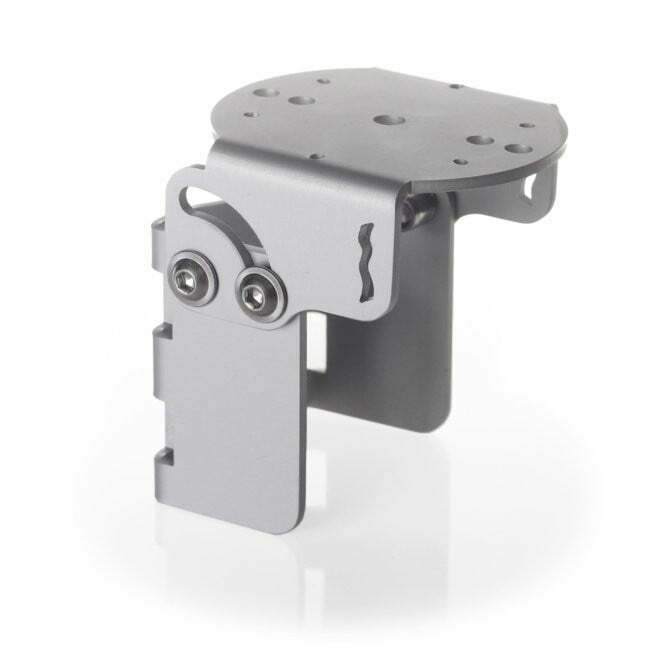 PMF01 is a practical metal bracket that helps mounting pyranometers on a vertical mast, horizontal crossarm, flat wall or a fence. It allows for horizontal as well as tilted (Plane of Array) orientation. The use of PMF01, compatible with all Hukseflux pyranometers, is easy. Its spring-loaded central bolt allows easy mounting and leveling. With its small footprint, in particular when combined with small footprint pyranometers such as SR30, PMF01 reduces problems with snow build-up; snow will simply drop off.
- Quick installation
- Easy levelling using spring-loaded bolt
- For mounting pyranometers on horizontal and vertical tubes, on platforms, both horizontal and in Plane of Array
-
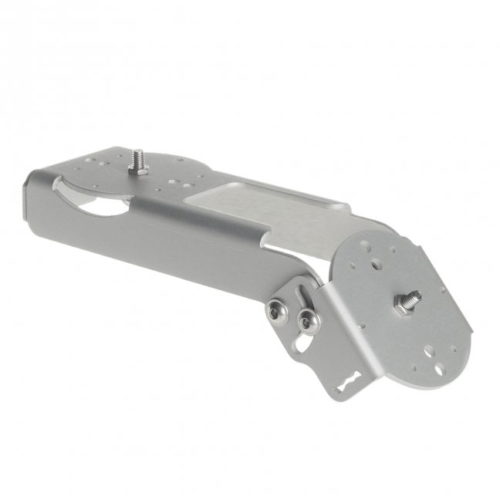 Model PMF02 enables a setup of two pyranometers, of which one in Plane of Array (POA), mounted to a frame or fence; ideal for PV system performance monitoring according to the latest IEC standards. PMF02 is compatible with all Hukseflux pyranometers.
- Ideal for PV monitoring
- Quick installation
- Easy leveling using a spring-loaded bolt
- For mounting two pyranometers to a frame or fence, one horizontal and one in Plane of Array (tilted)
-
 RA01 is a market leading 2-component radiometer, used in scientific-grade energy balance and surface flux studies. It offers 2 separate measurements of solar and longwave radiation. Product features include a modular design, low weight, and easy levelling, and low solar offsets in the longwave measurement. The unique capability to heat the pyrgeometer reduces measurement errors caused by dew deposition. When combined with estimates of solar albedo and of local surface temperature, this instrument can also be used for estimation of net radiation. The advantages of this approach are cost reduction and independence from local surface properties.
- Modular design, low weight and easy levelling
- Low solar offsets in the longwave measurement
- Unique capability to heat the pyrgeometer reducing measurement errors caused by dew
-
 SBG01 is a water-cooled sensor that measures heat flux. The ISO standards call this a heat flux meter. Introduced in 2008, SBG01 has rapidly become the sensor of choice for fire testing. SBG01 is mainly used to test reaction to fire and fire resistance. It is also used as a calibration reference standard for test equipment, for example in flammability and smoke chamber tests. SBG01 complies with the requirements of the most common ASTM and ISO standard test methods.
- Robust and serviceable water tubes
- Scratch resistant absorber coating (slightly lowered surface)
- Safe storage with a practical protection cap
- Durable cable with strain relief, temperature resistant up to 200 °C
-
 SHR02 is a shadow ring, used in combination with a pyranometer to form a "diffusometer". The ring will prevent direct radiation from reaching the pyranometer from sunrise to sunset, so that the shaded pyranometer measures diffuse radiation only. SHR02 is used with Hukseflux pyranometers such as SR30 and SR20. These models have very low zero offsets, leading to higher accuracy diffuse measurements than attained with competing models. SHR02 is compatible with most Hukseflux pyranometers. Hukseflux pyranometers have very low zero offsets, so that the diffuse radiation measurement has a better uncertainty than that of competing pyranometer-shadow ring diffusometers. To avoid problems with dew and frost deposition, the user should consider using the heated SR25 or the heated and ventilated SR30 pyranometer.
- Relatively small size / light weight
- Low-investment alternative for a sun tracker with shading-disc
- High accuracy when used with Hukseflux (low zero-offset) pyranometers
- Save costs on expensive external ventilation; compatible with SR30 with internal ventilation
-
 SR05 is the most affordable digital pyranometer meeting ISO 9060 second class requirements. It measures solar radiation received by a plane surface, in W/m2, from a 180 o field of view angle. SR05 is ideal for general solar radiation measurements in (agro-)meteorological networks and PV monitoring.
- Industry standard digital outputs: easy implementation and servicing
- Easy mounting and levelling
- Pricing: second class pyranometers finally affordable for large networks
-
 SR05 series is the most affordable range of pyranometers meeting ISO 9060 second class requirements. SR05 measures solar radiation received by a plane surface, in W/m², from a 180 ° field of view angle. It is ideal for general solar radiation measurements in (agro-)meteorological networks and PV monitoring. The pyranometer is easy to mount and install, in particular with SR05's ball levelling mechanism. Version SR05-D1A3 offers Modbus over RS-485 and 0-1 V output.
- Industry standard digital outputs: easy implementation and servicing
- Easy mounting and levelling
- Pricing: second class pyranometers finally affordable for large networks
-
 SR05 series is the most affordable range of pyranometers meeting ISO 9060 requirements. These sensors are ideal for general solar radiation measurements and popular for monitoring PV systems. Model SR05-D1A3–PV is made as a perfect alternative to PV reference cells. It offers the same Modbus interface as the most common PV reference cell model for easy compatibility. Relative to PV reference cells, SR05-D1A3-PV has the advantage of higher stability, independence of the PV cell type or anti-reflection coating, and better availability and price of recalibration.
- Higher stability than PV reference cells
- Independent of PV cell type
- Affordable calibration
- Register structure and content identical to most common reference cells for easy exchangeability
- Easy implementation and servicing
- Easy mounting and levelling
- Pricing: affordable second class pyranometers