• SR20-D2

    Digital Secondary Standard Pyranometer with Modbus RTU and 4-20 mA Output

    SR20-D2 is a solar radiation sensor of the highest category in the ISO 9060 classification system: secondary standard. SR20-D2 is designed for the solar PV industry, offering two types of commonly used irradiance outputs: digital via Modbus RTU over RS-485 and analogue 4-20 mA (current loop). These industry standards allow for easy data acquisition, easy read-out and error-free instrument exchange, when using SR20-D2. Individually tested for temperature and directional response, SR20-D2 is the most accurate digital secondary standard pyranometer available.

    • Digital output: easy implementation & servicing
    • Best-in-class temperature response, < ± 0.4 % (-30 to +50 °C), best  “zero offset a” and best calibration uncertainty
    • Test certificates for temperature response and directional response included as required by ISO 9060
    • Re-calibration registers fully accessible to users
  • SR22

    Secondary Standard Pyranometer with Quartz Domes - Extended Spectral Range

    SR22 is a solar radiation sensor of the highest category in the ISO 9060 classification system: secondary standard. On top of the features and benefits of the successful SR20 pyranometer, SR22 has domes made of high-quality quartz, resulting in an extended spectral range. Covering the full solar spectrum, SR22’s extended spectral range potentially offers lower measurement- and calibration uncertainties compared to pyranometers with glass domes. SR22 is typically used in high-accuracy climatological networks.
    • SR22’s spectral range of 190 to 4000 x 10-9 m. SR22 covers the full solar spectrum
    • SR22’s low temperature dependence makes it an ideal candidate for use under very cold and very hot conditions
    • SR22 pyranometer uses a state of the art thermopile sensor with black coated surface

  • SR25

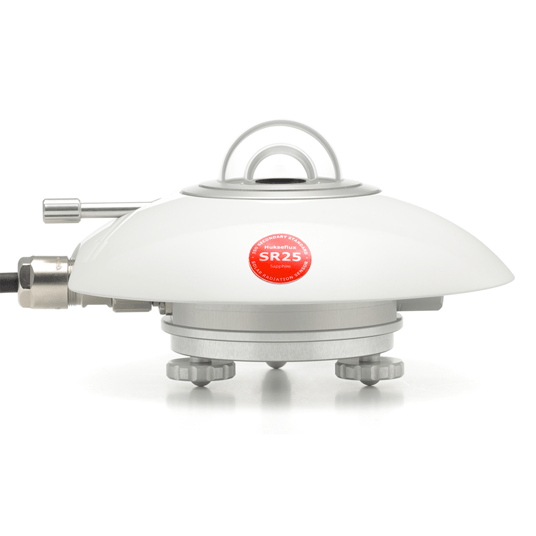
    Spectrally Flat Class A Pyranometer with Sapphire Outer Dome

    SR25 takes solar radiation measurement to the next level. Using a sapphire outer dome, it has negligible zero offsets. SR25 is heated in order to suppress dew and frost deposition, maintaining its high measurement accuracy. When heating SR25, the data availability and accuracy are higher than when ventilating traditional pyranometers. In addition, SR25 needs very low power; it only consumes 1.5 W compared to the usual 10 W for ventilation. The low thermal offsets make SR25 very suitable for measuring diffuse radiation.
    • Data availability is highly increased over traditional pyranometers
    • Needs very low power
    • SR25 is an excellent reference for diffuse radiation
  • SR30-M2-D1

    Digital Class A (secondary standard) Pyranometer with Heating and Tilt Sensor

    Welcome to the next level in solar radiation monitoring! The all-digital heated SR30-M2-D1 offers the highest accuracy and highest data availability: using Recirculating Ventilation and Heating (RVH™) technology, SR30 outperforms pyranometers equipped with traditional ventilation systems. SR30 is the ideal instrument for use in PV system performance monitoring and meteorological networks. It measures the solar radiation received by a plane surface, in W/m², from a 180 ° field of view angle. SR30 is an ISO 9060 spectrally flat Class A (previously “secondary standard”) pyranometer. It is employed where the highest measurement accuracy is required. SR30-M2-D1 offers several advantages over competing pyranometers:
    • Heated for high data availability, featuring new RVH™ technology
    • Compliant with IEC 61724-1:2017 Class A and B
    • Low cost of ownership
    • Remote sensor diagnostics
    • Liabilities covered: test certificates

Go to Top